MethodsWhat's actually free?
Sign inStart for free

Your partner for learning theater and film scripts

Download on theApp StoreGET IT ONGoogle Play

Synqro

  • Methods
  • Pricing
  • Blog

Help

  • Frequently asked questions
  • support@synqro.app

Legal

  • Terms of Service
  • Terms of Use
  • CGV
  • Privacy Policy
  • Audience measurement

© 2026 Synqro · All rights reserved

Français·English (United Kingdom)·English (United States)·English (Canada)·Deutsch (Deutschland)·Deutsch (Österreich)·Español·Italiano·Čeština·Nederlands·Polski·Português (Portugal)·Português (Brasil)
All articles

26 October 2026 · 5 min read

How to Learn Lines Without Rote Repetition: What Research Learned from Actors

For nearly twenty years, Helga and Tony Noice studied how actors memorize their roles. Their most useful finding is also the most surprising one.
The question actors hear most often is "How do you remember all that?" Two American researchers, Helga and Tony Noice, took it seriously. They spent nearly twenty years interviewing professional actors, then testing their techniques in the lab, and they summed up that work in 2006 in the journal Current Directions in Psychological Science.

The first finding is a little deflating for the question: actors don't think of memory as their job. What they care about is playing truthfully and listening. Michael Caine made the point in a 1990 book the two researchers cite: you have to be able to stand there without thinking about your line and pick it up from the other actor's face. Otherwise you aren't listening for your next line, and you aren't free to react naturally.

And yet they know their lines word for word. In the United States, the Noices point out, the standard playwrights' contract even allows an actor who strays from the script to be replaced. The real question is how you get to that level of precision without drilling the text over and over.

What actors say

The researchers started by collecting more than a hundred accounts from actors describing how they work. Almost none of them learn by mechanical repetition. One actor summed it up: the thing they don't do is memorize right away; if anything, the problem is keeping themselves from memorizing too soon.

What they do instead looks like detective work. For each section of a scene, they look for what the character wants. These sections are called beats: the smallest stretch of text aimed at a single goal. One actress had broken half a page of dialogue into three beats: flatter him, get him talking, calm his fears. The flattery works, so she can get him talking, so she can reassure him. The text becomes a chain of causes, and a chain is easier to remember than a string of sentences.

Sometimes the work goes all the way down to a single word. In the play The Front Page, the mayor tells a reporter, "Don't pester me now, please." One actor noticed that pester is usually said of an annoying child: the mayor is treating the reporter like a kid. But he adds "now," because he doesn't want to fall out with someone who might be useful to him later, and the "please" softens the whole thing. Every word has a reason to be there. That reason is what you remember, and the word comes along with it.

The experiment that failed

The next question was whether this can be taught. The Noices taught students to analyze a script the way actors do, asking themselves questions like "Am I flirting with her when I say this?" Compared with students who simply read the text, the analysis group did better. Compared with students who were allowed to memorize it with their usual method, it lost by a wide margin: 57% of the text recalled with rote learning, 33% with analysis.

This is our favorite part of the article, because it breaks a common belief among amateur actors: picking your script apart at the table isn't enough. So the researchers turned to the other half of an actor's work, the rehearsal process. The new instruction to students: don't try to remember the words, try to say them for real to someone, present or imagined, to get something from them (warn them of a danger, win them over). This time the results flipped, with 60% of the text recalled versus 50% for rote memorization.

Your lines, at your fingertips

Import your play into Synqro: your lines highlighted, the Italian run-through to give you the cue, and games to remember it. Free.

Rehearse your first text

Read next

  • Learn Your Lines at Night, Review Them in the Morning: What Sleep Does to Your Memory

    26 October 2026

    Learn Your Lines at Night, Review Them in the Morning: What Sleep Does to Your Memory

  • The Unsung Roles That Keep a Theater Troupe Going

    11 August 2026

    The Unsung Roles That Keep a Theater Troupe Going

  • Fill-in-the-Blank Text: How to Check Whether You've Really Learned Your Lines

    9 August 2026

    Fill-in-the-Blank Text: How to Check Whether You've Really Learned Your Lines

They called it active experiencing: using everything you have, voice, body, emotion, to get the meaning across to someone. According to them, the result has been replicated many times, with other groups of people and other texts.

Bring your body into it

The last ingredient is movement. In a study published in 2000, actors remembered lines they had spoken while moving better than lines spoken standing still, even when they weren't asked to repeat the movements during the test.

Careful, though: miming doesn't help. Nobody says "I'm walking to the door" while walking to the door. The Noices' example is subtler: a character is told to leave, replies "I'm very comfortable here," and sits down in an armchair. The gesture doesn't describe the sentence, but both serve the same goal: defying the other person. The researchers found this effect in the lab with students who had no theater experience at all, after just a few minutes of explanation.

What you can try tonight

Read your scene looking for what your character wants, line by line, and write an action verb in the margin: convince, trap, reassure, stall for time. At this stage, don't try to memorize anything.

Next, say your lines to someone. A scene partner if you have one handy; otherwise, a person you picture very precisely, sitting across from you, whom you want to get to do something. That's what happens when you do an Italian run-through in Synqro: the app speaks the other parts and you answer a voice, not a page.

Get up on your feet as soon as you can. Look for a move or a gesture that serves the intention of the line (not one that illustrates it).

Check the exact wording last, because the playwright and your director care about it. Blank text and Initials are built for this: they expose the synonyms you slipped in without noticing. The Your lines mini-game, which listens to what you say into the microphone, does the same check out loud.

The limits

These studies use English-language texts, often short ones, with American students or actors. Nobody has measured the effect on a three-hour role in alexandrines (the twelve-syllable rhyming verse of French classical theater), and we'd be curious to see the result. The failed experiment is also a reminder that the actors' method doesn't let you skip the work: it takes just as much effort, but directed at meaning and at your scene partner rather than at the page. A text you've already started to play holds up better than a text you recite, and that's still the best reason to get out of your chair as early as possible.

Sources

  • Helga Noice and Tony Noice, "What Studies of Actors and Acting Can Tell Us About Memory and Cognitive Functioning," Current Directions in Psychological Science, vol. 15, no. 1, 2006, pp. 14-18. Read the article (PDF)
  • American Psychological Society, "To Be Or, Or ... Um ... Line! Research Puts Actors' Memory On Center Stage," republished by ScienceDaily, January 27, 2006.
  • Michael Caine, Acting in Film, 1990, cited by Noice and Noice (2006).

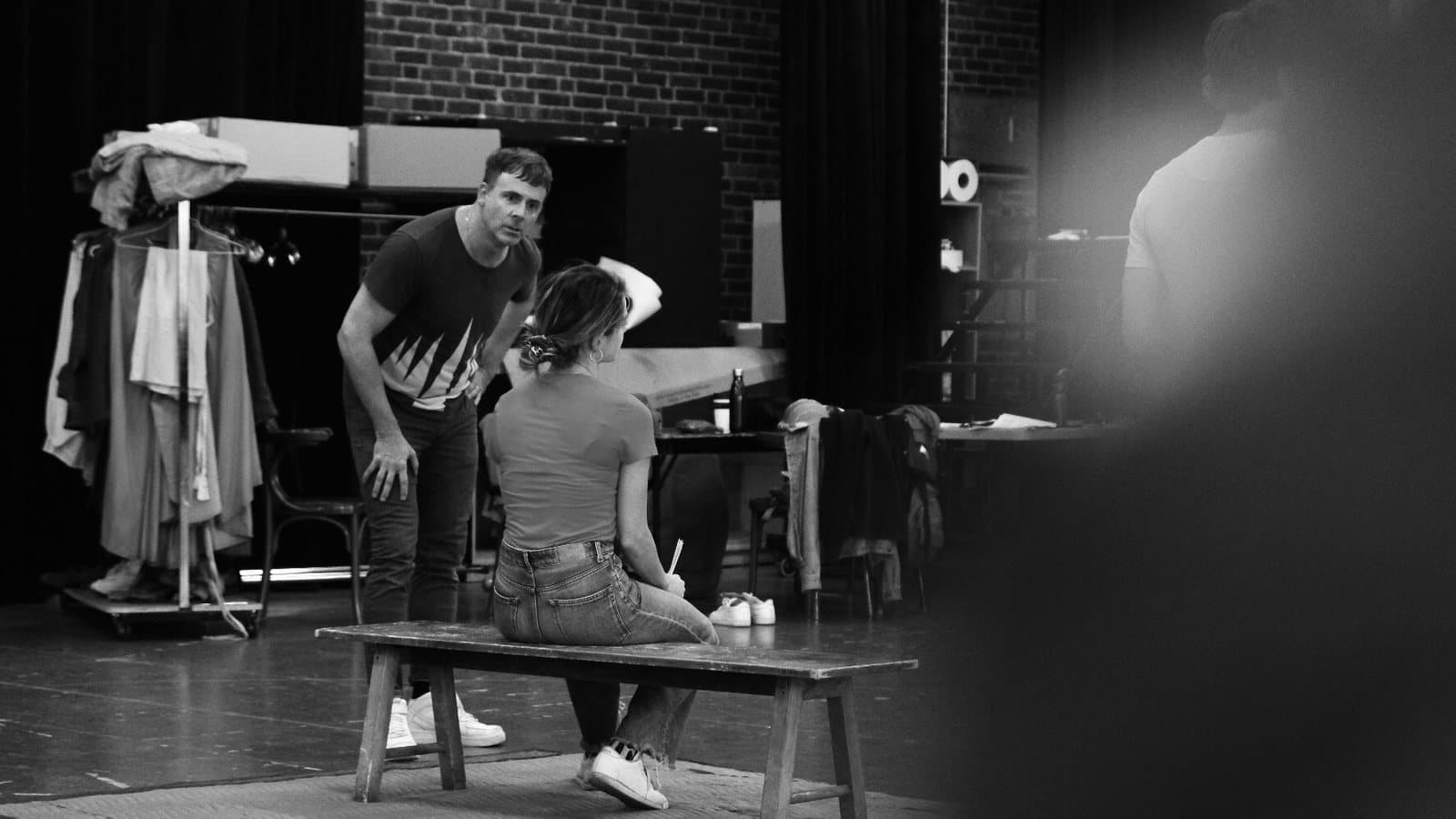
Cover photo: rehearsal of the play Les amoureux at the Théâtre Denise-Pelletier in Montreal, with Éric Bernier and Catherine Chabot. Photo by Isabeau Blanche, license CC BY-SA 4.0, cropped.